Why footprint math will never get you to zero, and what to build instead.
Every organization I work with that takes sustainability seriously runs the same four steps. Measure the footprint. Shrink what you can. Report it. Buy an offset for the remainder.
The first three are real work. The fourth is where the room goes quiet.
Most of the people running that sequence know the last step is largely paper. They have read the investigations. They understand that a certificate representing a forest nobody was going to cut down is not the same thing as carbon that stopped existing. They buy them anyway, because the alternative looks like admitting you did not reach zero, and nobody wants to write that sentence in an annual report.
So let me write it. You are not going to reach zero.
Not your company, not your school district, not your county, and not me. I have spent forty years in this work, and I have never seen an organization get there, because it is not arithmetic that closes. You will reduce. You should reduce. And there will be a remainder, and the remainder is real.
That is not a failure of will. It is a property of being alive and doing anything at all.
The half nobody sells you
I came to this from the trails. In the 1970s, I was a young man running the mountains for West Virginia, and I thought about my footprint in the literal sense: prints in the mud, in places I loved. What you carry in, you carry out. Leave it better than you found it.
It took me another thirty years to notice the contradiction sitting inside that phrase. You cannot leave a place better than you found it by taking less. Taking less is still taking. Better requires that you put something down.
If you want the shortcut, use the Rs. Reduce, reuse, recycle: the three you learned in school, and every one of them is subtractive. Take less. Use it longer. Send it around again. Good work, all three, and not one of them puts anything down that was not there before.
Which is why I had been adding two more for years. Rethink the upstream question: what should this have been in the first place? And regenerate, which is the whole point: put back more than you took. Three Rs for the footprint. Two for the handprint. The reason the original three have always felt insufficient is not that you are doing them wrong. It is that they were only ever half the ledger.
So I had the shorthand. What I did not have was a way to measure any of it, and a shorthand without measurement is a slogan.
That changed in the middle of the last decade. I had brought a cohort of West Virginia teachers to a Green Building Alliance professional development program, and I sat in on a session led by Greg Norris, a lifecycle assessment expert. He called it handprinting.
The distinction fits on an index card. Your footprint is the harm you cause. Your handprint is the good you create that would not have existed otherwise. You assess the footprint to understand your impact. You build handprints to leave the place better than you found it. Neither one cancels the other, and you need both.
The idea is not mine, and my firm did not invent it. What I recognized in that room was that I had been doing it for thirty years without knowing what to call it. Every program I ever started was a handprint. I had just thought of it as the job.
Why a handprint beats a certificate
Set an offset and a handprint side by side, and the comparison is not close.
A handprint exists in a place. You can drive to it. Your people can walk through it. An offset exists in a registry, and the registry is somewhere else.
A handprint is yours. Nobody can retire it, resell it, or discover three years later that it was never additional. You built it. It is on your ground with your name on it.
A handprint is visible to your own staff. This is the part that the finance conversation misses. Nobody was ever proud to work at a company that bought a good certificate. People are proud to work at a company that has built something. That is a retention argument, and it does not appear anywhere on the offset invoice.
A handprint compounds. An offset expires. A program grows, or it does not, and either way, you learn something. The school district that builds a working outdoor classroom has an asset in year ten. The one who bought credits in year one has a receipt.
The obvious objection
Is this not just a nicer way to avoid reducing?
It can be. If you build handprints instead of shrinking your footprint, you have committed the same fraud in a better outfit, and you have done it while feeling good about yourself, which is worse. The whole point of the pairing is that it is a pairing. You measure. You reduce. And then you also build.
The discipline that keeps it honest is measurement, which is not incidental to its origin. Greg Norris is a lifecycle assessment expert. Handprinting was not born as a feel-good frame; it was born next to the math. If you cannot measure a handprint, you do not have a handprint. You have a press release.
That is the standard I would hold any of this to, including my own.
What it looks like when it works
A few years ago, I directed the sustainability side of a federal program through WVU Extension, working with Appalachian manufacturers. The premise was not that these companies needed to be fixed. Most of them were already making sustainably sourced products because that is what the materials, geography, and labor around here produce. What they lacked was proof and a route to market.
So we helped them run lifecycle assessments and rebuild the business processes that connect a product to the demand side of the economy.
Look at what that actually is. The LCA is footprint work: measure honestly, know your impact. But the thing it enabled was a handprint, a regional supply chain that had not existed, built out of capacity that was already sitting there. The measurement was in service of the building. That is the whole method in one program.
Schools are the same story in a different key. I have watched school after school start a recycling program and conclude that it is now a sustainable school. The bin is nothing. But a bin is comprehension, not action.
Think about literacy, which is the other half of my career. A child who can decode the words on a page is not literate. A child who decodes and also comprehends is closer, but still not there.
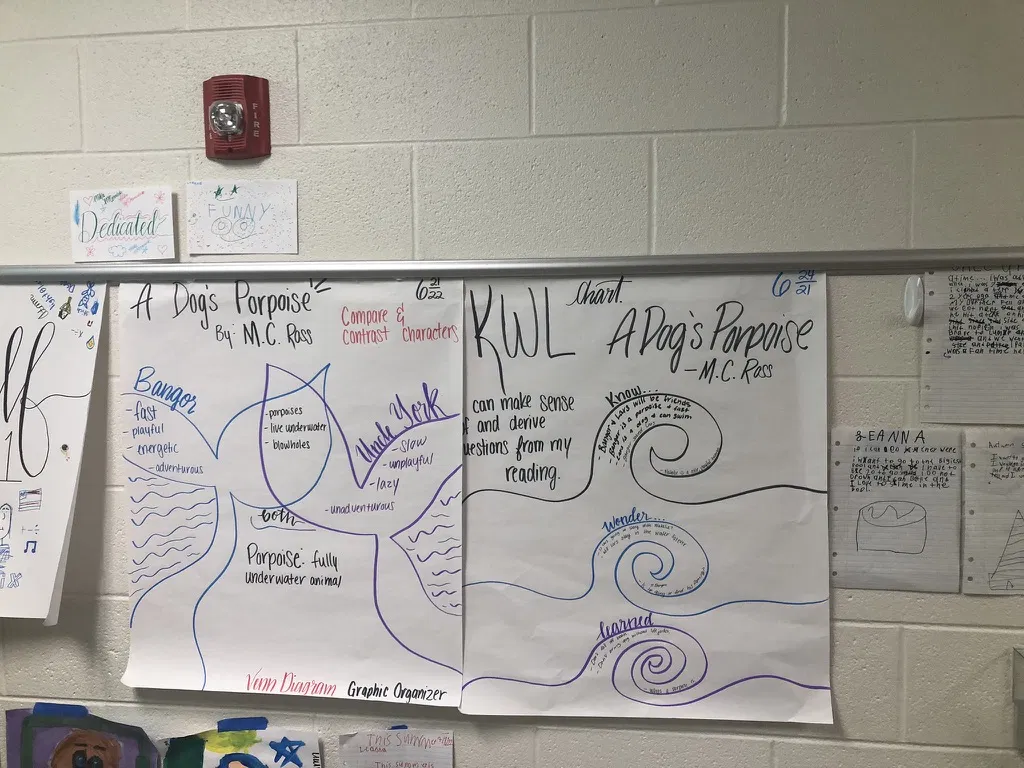
Literacy is realized when the child does something with what they understood: argues it, applies it, teaches it, and builds on it. Knowing, understanding, and then articulating. Stop at the second stage, and what you have is a student who can pass a quiz.
Sustainability has the same three stages, and most schools stop at two. They know. They understand. There is a bin in the hallway and a poster above it. What is missing is the doing, and the doing is what problem-based learning is for: put a real problem in the students’ own place, in front of them, and ask what they intend to do about it. I was certified as a Problem-Based Learning trainer by NASA’s Classroom of the Future and spent the better part of two decades teaching it, and it took me a long time to see that it was the same thing. A handprint is a project. Good pedagogy and good sustainability turn out to be the same instruction, which is not a coincidence.
A certification as a green building does not make a school sustainable either. I have consulted on the first LEED-certified schools in my state, and I can tell you that a building with excellent windows and a culture that ignores them is just an expensive building. The handprint is what the people inside it do.
What are you going to build?
If you run an organization, you already know your footprint number, or you can get it. That work is well developed, and there are competent people who will do it for you.
The question I would ask next is the one almost nobody asks. Given that you will not reach zero, what is the positive thing you are going to build, in a real place, that would not exist otherwise, that you can measure, that your own people can see?
That is not a softer question than the one about the footprint. In some ways, it is harder, because a certificate can be purchased in an afternoon, and a handprint takes a plan.
But it is the one that leaves the place better than you found it. And it is the only half of the ledger where you get to decide what goes in it.
Mark Swiger is the founder of Pangaea Strategies. He has spent forty years building programs in education, athletics, and sustainability in Appalachia.

